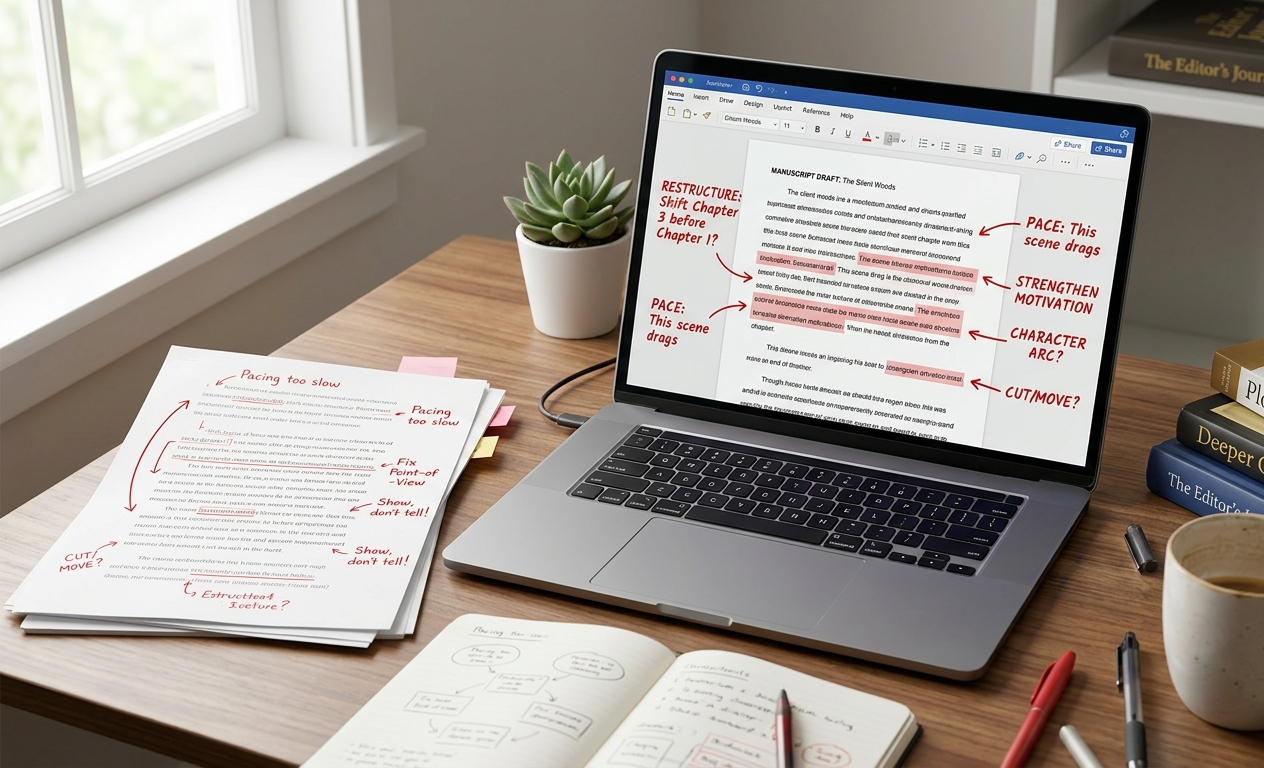
How Developmental Editing Improves a Manuscript
Congratulations! You’ve finished your manuscript. After months or even years of writing, revising, and second-guessing yourself, you’ve reached the end.
Now what?
Many writers assume the next step is copyediting or proofreading. But before anyone focuses on grammar, punctuation, or word choice, it’s important to ask a bigger question:
Does the manuscript work?
That’s where developmental editing comes in.
Developmental editing, sometimes called content editing, examines the big-picture elements of a manuscript. It focuses on structure, pacing, character development, organization, clarity, theme, and overall effectiveness. Rather than correcting sentences, a developmental editor helps ensure that the manuscript is accomplishing what it sets out to do.
For many writers, developmental editing is one of the most valuable stages of the revision process because it addresses foundational issues before they become harder and more expensive to fix later.
What Is Developmental Editing?
Developmental editing looks at the manuscript as a whole.
Instead of focusing on grammar and sentence-level concerns, a developmental editor evaluates the larger elements that shape the reader’s experience.
For fiction writers, this often includes:
- Plot and story structure
- Character development
- Pacing
- Point of view
- Conflict and stakes
- Worldbuilding
- Theme
The goal is not to rewrite the manuscript for the author. The goal is to help the author create the strongest possible version of their work.
Why Writers Need Developmental Editing
Writers spend so much time immersed in their projects that it can become difficult to evaluate them objectively.
You know your characters. You understand the backstory. You know what every scene is supposed to accomplish…Your readers don’t.
A developmental editor provides the outside perspective that writers often need. They can identify areas where readers may become confused, lose interest, or struggle to connect with the material.
This perspective helps uncover issues that are often invisible to the writer but obvious to the reader.
Developmental Editing Strengthens Story Structure
A compelling story requires more than a great idea.
Even the most creative premise can fall flat if the structure isn’t working.
Developmental editors examine how the story unfolds and whether each scene contributes to the overall narrative. They look for issues such as:
- Slow beginnings
- Sagging middle sections
- Rushed endings
- Missing plot points
- Unclear motivations
- Scenes that don’t advance the story
By identifying structural weaknesses, developmental editing helps create a stronger foundation for the entire manuscript.
Developmental Editing Deepens Character Development
Readers connect with characters, not plots.
Even a fast-paced story can struggle if readers don’t care about the people on the page.
A developmental editor evaluates whether characters feel believable, consistent, and emotionally engaging. They may ask questions such as:
- Does the protagonist have clear goals?
- Are character motivations understandable?
- Do characters grow and change?
- Are supporting characters serving a purpose?
- Are character actions consistent with who they are?
Strong characters create emotional investment, and emotional investment keeps readers turning pages.
Developmental Editing Improves Pacing
Pacing is one of the most common challenges writers face.
A manuscript may contain excellent scenes but still feel too slow, too rushed, or uneven overall.
Developmental editors examine how information is delivered throughout the manuscript. They identify places where readers may become bored, confused, or overwhelmed.
This might involve:
- Tightening repetitive sections
- Expanding underdeveloped scenes
- Reordering information
- Increasing tension
- Improving transitions
The result is a reading experience that feels smoother and more engaging from beginning to end.
Developmental Editing Reveals Missed Opportunities
Sometimes a manuscript isn’t broken. It’s simply not reaching its full potential.
Developmental editors often identify opportunities for greater emotional impact, stronger themes, deeper conflict, or richer storytelling.
For example, they may notice:
- A secondary character who deserves more development
- A theme that could be strengthened
- A subplot that needs resolution
- A conflict that could carry greater stakes
- A chapter that could create more tension
These insights help elevate a manuscript beyond simply being functional and move it closer to being memorable.
Developmental Editing Helps Writers Grow
One of the greatest benefits of developmental editing is that it doesn’t just improve the current manuscript. It improves the writer.
A good developmental editor explains why certain elements aren’t working and offers guidance for strengthening them. Over time, writers begin to recognize these issues themselves.
As a result, developmental editing becomes both a revision tool and a learning experience.
Writers often leave the process with a deeper understanding of storytelling, structure, pacing, and reader expectations.
What Developmental Editing Is NOT
Because there are several types of editing, it’s easy to confuse developmental editing with other editorial services.
Developmental Editing Is Not Copyediting
Copyediting focuses on grammar, punctuation, spelling, consistency, and sentence-level clarity.
Developmental editing focuses on the manuscript’s structure, content, and overall effectiveness.
A manuscript may have perfect grammar, etc., and still require significant developmental work.
Developmental Editing Is Not Proofreading
Proofreading is the final stage of editing before publication.
Proofreaders look for small errors that remain after revisions are complete.
Developmental editing happens much earlier in the process and focuses on larger issues.
Developmental Editing Is Not Rewriting
A developmental editor does not write the book for you.
Instead, they provide feedback, recommendations, and guidance that help you make informed revision decisions.
The manuscript remains your work, your voice, and your vision.
When Should You Hire a Developmental Editor?
Developmental editing is most valuable after you’ve completed a draft and revised it to the best of your ability.
While every writer’s process is different, developmental editing is often the next step when:
- You’ve finished a manuscript but know it needs work
- Beta readers have identified recurring issues
- You’re struggling to solve story problems
- The manuscript feels “off” but you’re not sure why
- You’re preparing to query agents or pursue publication
- You want professional feedback before investing in later editing stages
The earlier major issues are identified, the easier they are to address.
The Long-Term Value of Developmental Editing
Developmental editing requires vulnerability.
It can be challenging to hear that parts of a manuscript need significant revision. Yet this process often leads to the greatest improvements.
Strong books are rarely created through first drafts alone. They emerge through thoughtful revision, honest feedback, and a willingness to strengthen what isn’t yet working.
Developmental editing provides a roadmap for that process.
Rather than guessing what needs to change, writers gain clear direction and actionable feedback that helps them move forward with confidence.
Developmental Editing at Gemini Writer’s Studio
At Gemini Writer’s Studio, we believe every manuscript has the potential to become stronger.
Our developmental editors will work closely with you to identify strengths, uncover opportunities for improvement, and provide clear, constructive feedback that supports both the manuscript and the writer behind it.
Whether you’re working on a novel or short fiction, developmental editing can help you create a more compelling, engaging, and effective manuscript.
Ready to take your manuscript to the next level?
For SEO: This piece should perform well for keywords such as developmental editing, content editing, what is developmental editing, developmental editor, book editing services, and how developmental editing improves a manuscript, while naturally funneling readers toward your editing services page.